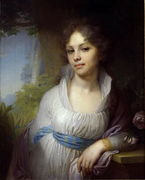
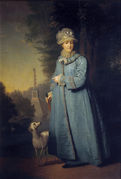
"Портрет Марии ивановны Лопухиной", 1797
|
«Портрет М. И. Лопухиной» является заказом ее мужа, егермейстера и действительного камергера при дворе С. А. Лопухина.
Эта картина - признанный шедевр Боровиковского - представляет абсолютное воплощение эстетических идей сентиментализма. Образ Марии Лопухиной пленяет нежной меланхоличностью, необыкновенной мягкостью черт лица и внутренней гармонией, которая ощущается во всех художественных и живописных элементах картины: в позе героини, повороте очаровательной головки, выражении лица. Гармоничны и мелодичны все линии, привлекают внимание детали. На полотне также изображены цветы - сорванные и уже слегка поникшие на стебле розы. Что это, зарисовка природы или здесь заключен некий смысл? Символическое значение цветов было хорошо известно: красота их цветения завораживает, но очень скоро блекнет. Такова и красота женщины.
Однако художника особенно привлекают нюансы в состоянии модели, ее ускользающая красота, глубокая грусть души, которые он передает благодаря почти незаметным элементам символики и тонкому колористическому решению портрета.
По оценке знатоков искусства, «Портрет Марии Ивановны Лопухиной» является одним из шедевров автора. Именно его можно считать началом нового этапа в портретной живописи - когда художник обозначает не социальное положение и значимость героя картины, а его личностные характеристики – настроение, сокровенные переживания. Выражается это в изображении не атрибутов в интерьере, а окружающей природы.
На полотне Боровиковского - Мария Лопухина, молодая девушка 18-ти лет, она из дворянского рода, дочь генерала в отставке Ивана Андреевича Толстого, жена Степана Авраамовича Лопухина. Мария только что вышла замуж, и этот портрет послужил ей подарком от мужа. Портрет завораживает и очаровывает с первого же взгляда.
Девушка изображена на фоне природы, размытой и как бы в дымке, через которую просматриваются русские мотивы – березы, цветы, облака. Мария в белом, простом платье с голубым поясом, охватывающем ее фигуру по «греческой» моде, в небрежно накинутой шали.
Милое, обаятельное лицо молодо, свежо и нежно, у нее мечтательный взгляд, направленный именно на вас, и легкая таинственная улыбка. По замыслу автора, вся картина должна создавать ощущение гармонии и единства природы и человека.
Красота девушки грациозно и непринужденно сливается с красотой пейзажа. Как гармонирует наклоненная березка с естественным и плавным изгибом фигуры девушки, как васильки откликаются на цвет пояса, как золотые колосья передают изгиб руки, цвет и фактуру браслета.
Боровиковскому удалось передать не только поразительное сходство с оригиналом, но и наполнить полотно поэтичностью, выразившейся в воздушности письма и нежной гамме красок. Используя в основе приглушенные серебристые, бледно-голубые, нежно-зеленые цвета, автор достигает особенной лиричности и чувственности изображения.
По словам современников художника и искусствоведов нашего времени, портрет Лопухиной является идеалом женщины именно русского типа, которому, согласно канонам сентиментализма, Боровиковский придал черты нежной чувствительности, а изображение природы – как неотъемлемая часть женской души, ее сущности.
Благодаря портрету Боровиковского, до наших дней сохранилась загадочная красота Марии Лопухиной. А судьба девушки оказалась сурова к ней, Мария умерла в возрасте 23-лет от чахотки.
Интересно, что после ее смерти прокатились по городу слухи, что именно этот портрет и погубил, совсем недавно здоровую и жизнерадостную девушку. В кулуарах шептались, что якобы любая девушка, посмотревшая на этот портрет, умрет, потому что в нем воплотился дух умершей. Скорее всего, эти слухи связаны с отцом Марии, он являлся членом масонской ложи, увлекался мистицизмом и имел огромное влияние на умы окружающих.
В какой-то степени, Боровиковский «виноват» в этих слухах – вот какова сила его художественного таланта, его воздействия на людей, как высока эстетическая составляющая портрета, какова жизненность и достоверность изображенной на нем героини.
Только почти через 100 лет эти слухи перестали будоражить людей. После того, как знаменитый российский предприниматель и коллекционер Павел Михайлович Третьяков, приобрел картину для собрания своей галереи.
"Portrait of M. I. Lopukhina" is an order of her husband, the huntsman and the actual chamberlain at the court of S. A. Lopukhin.
This painting - a recognized masterpiece of Borovikovsky-represents the absolute embodiment of the aesthetic ideas of sentimentalism. The image of Maria Lopukhina captivates with a gentle melancholy, unusual softness of facial features and inner harmony, which is felt in all the artistic and picturesque elements of the picture: in the pose of the heroine, the turn of the charming head, the expression of the face. All lines are harmonious and melodic, details attract attention. The canvas also depicts flowers-plucked and already slightly drooping on the stem of a rose. Is this a sketch of nature, or is there some meaning here? The symbolic meaning of flowers was well known: the beauty of their flowering is fascinating, but very soon fades. Such is the beauty of a woman.
However, the artist is particularly attracted by the nuances in the state of the model, its elusive beauty, deep sadness of the soul, which he conveys thanks to almost imperceptible elements of symbolism and a subtle coloristic solution of the portrait.
According to art experts, "Portrait of Maria Ivanovna Lopukhina" is one of the author's masterpieces. It can be considered the beginning of a new stage in portrait painting - when the artist does not designate the social position and significance of the hero of the picture, but his personal characteristics – mood, intimate experiences. This is expressed in the image of not the attributes in the interior, but the surrounding nature.
On the canvas of Borovikovsky is Maria Lopukhina, a young girl of 18 years old, she is from a noble family, the daughter of retired General Ivan Andreevich Tolstoy, the wife of Stepan Avraamovich Lopukhin. Maria had just got married, and this portrait served as a gift from her husband. The portrait fascinates and fascinates at the first glance.
The girl is depicted against the background of nature, blurred and as if in a haze, through which Russian motifs are viewed-birches, flowers, clouds. Maria is wearing a white, simple dress with a blue belt that covers her figure in the "Greek" fashion, with a shawl casually thrown over her.
Her sweet, charming face is young, fresh and tender, she has a dreamy look directed specifically at you, and a light mysterious smile. According to the author, the whole picture should create a sense of harmony and unity of nature and man.
The beauty of the girl gracefully and naturally merges with the beauty of the landscape. How the tilted birch tree harmonizes with the natural and smooth curve of the girl's figure, how the cornflowers respond to the color of the belt, how the golden ears convey the bend of the arm, the color and texture of the bracelet.
Borovikovsky managed to convey not only a striking similarity with the original, but also to fill the canvas with poetry, expressed in the lightness of the letter and a delicate range of colors. Using muted silver, pale blue, and pale green colors as the basis, the author achieves a special lyricism and sensuality of the image.
According to the artist's contemporaries and art historians of our time, the portrait of Lopukhina is the ideal of a woman of the Russian type, to which, according to the canons of sentimentalism, Borovikovsky gave features of tender sensitivity, and the image of nature is an integral part of the female soul, its essence.
Thanks to the portrait of Borovikovsky, the mysterious beauty of Maria Lopukhina has been preserved to this day. And the fate of the girl turned out to be harsh to her, Maria died at the age of 23 from consumption.
It is interesting that after her death, rumors swept through the city that it was this portrait that destroyed, quite recently, a healthy and cheerful girl. It was whispered on the sidelines that supposedly any girl who looked at this portrait would die, because the spirit of the deceased was embodied in it. Most likely, these rumors are connected with Maria's father, he was a member of a Masonic lodge, was fond of mysticism and had a huge influence on the minds of others.
To some extent, Borovikovsky is "to blame" for these rumors – this is the strength of his artistic talent, his influence on people, how high the aesthetic component of the portrait is, what is the vitality and authenticity of the heroine depicted on it.
Only after almost 100 years, these rumors have ceased to excite people. After the famous Russian entrepreneur and collector Pavel Mikhailovich Tretyakov purchased the painting for the collection of his gallery.
Реклама / Спонсор публикации:
Масляная живопись для взрослых ( Художественная школа "Дом художников")
Изготовим копию этой картины - любого размера и в срок.
We will make a copy of this painting - of any size and on time.
Подпишитесь на наш Telegram канал:
Новые статьи, арт-новости
Изготовим копию этой картины - любого размера и в срок.
|
|



 Главная / Обратная связь
 Обратная связь
 Регистрация
 Вход
Вход Музеи
Музеи Список альбомов
 Последние добавления
 Последние комментарии
 Часто просматриваемые
 Лучшие по рейтингу
 Избранные
 Поиск картины