Главная›Галерея›Альбомы художников›Венецианов Алексей Гаврилович 1780-1847›"Причащение умирающей", 1839
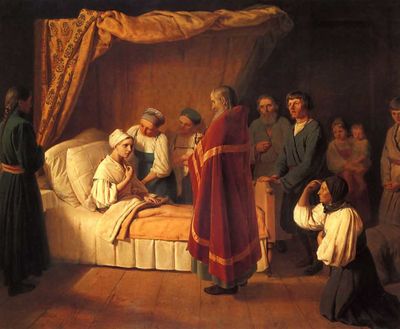
"Причащение умирающей", 1839
Государственная Третьяковская галерея
Картина «Причащение умирающей» написана в 1839 году – когда Венецианову было под шестьдесят. Это был не самый легкий период его жизни - в 1831 году от холеры умерла жена, часто болели он и дочь – всё это сказалось на настроении художника и его обращении к теме религии.
Специалисты утверждают, что Венецианов стал первым в русской живописи, кто запечатлел такую важную процедуру как причащение умирающей (евхаристию). В старой России этот обычай был чрезвычайно распространен – умереть без последнего причастия считалось не праведным. Известно немало случаев, когда после причащения умирающий больной вдруг шел на поправку и, в конце концов, выздоравливал – так что этот обряд был еще и жестом последней надежды на чудо, что при уровне медицины тех времен было вполне понятным.
Сам художник назвал картину «Причащение больной женщины Святых Тайн». Но почти сразу каждый стал называть картину на свой лад - «Приобщение Святых Тайн больной крестьянской женщины», «Больная молодая крестьянка в постели готовится к причащению Святых Тайн». В 1862 году на Международной выставке в Лондоне под ней появилось название «Причащение крестьянки». Сейчас она известна именно как «Причащение умирающей»
Даже беглого знакомства с картиной достаточно чтобы понять, что умирает на ней явно не крестьянка. Тут вам и расшитый полог над кроватью, и тщательно заправленные складки простыней, и крупная икона в пышном позолоченном окладе. Скорее всего, причащается здесь молодая барыня или барышня-помещица. Заметим, что в оригинальном названии картины слово «крестьянка» и не присутствует
Из выразительных деталей стоит обратить внимание, что принимающая причастие находится как бы в пятне света, что символизирует снизошедшую на неё божью благодать. Так же специалистов восхищает то, что героины картины находится не в центре, а смещена чуть влево почти по законам традиционного "золотого сечения" относительно середины между группой священнослужителей. В общей композиции полотна "масса тени" подобным же образом взаимодействует с "массой света". (Вы что-нибудь поняли из этого? Я нет. Но если заучить наизусть, то при случае можно блеснуть интеллектом)
Критики этой картины Венецианова считают его одним из самых немощных из всех его созданий. По их мнению, трагедия смерти на картины выхолощена совершенно, умирающая выглядит совершенно здоровой (и этот жест как бы говорит – это я умираю?), на полу – ни соринки, а крестьяне, собравшиеся проводить умирающую в последний путь,— мужики, бабы, дети — все тоже чистенькие, выглаженные и приглаженные, принаряженные и приукрашенные. В общем, сплошная идиллия и пейзанство.
Что до самого Венецианова, то своё причащение перед смертью он получить не успел – зимой 1847года художник отправился на санях в Тверь, по дороге норовистые лошади (кстати, выменянные им у монахов Николо-Теребинского монастыря взамен образов, написанных для храма - может стоило их просто подарить?) понесли, возница из соней выпал из спасся, а вот Венецианов попытался схватив вожжи остановить сани. «Резким толчком и его выбросило на обледенелую дорогу. Вожжей он не отпустил, и его тело стремительно летело по дороге, ударяясь обо все встречное». Крестьяне нашли его уже бездыханным.
"Communion of a dying woman", 1839
The State Tretyakov Gallery
The painting "Communion of the dying" was painted in 1839 – when Venetsianov was under sixty. It was not the easiest period of his life - in 1831 his wife died of cholera, he and his daughter were often ill – all this affected the artist's mood and his appeal to the topic of religion.
Experts say that Venetsianov was the first in Russian painting who captured such an important procedure as the communion of the dying (the Eucharist). In old Russia, this custom was extremely common – it was considered not righteous to die without the last communion. There are many cases when, after communion, a dying patient suddenly went on the mend and, in the end, recovered – so this rite was also a gesture of the last hope for a miracle, which was quite understandable at the level of medicine of those times.
The artist himself called the painting "Communion of a sick woman of the Holy Mysteries". But almost immediately everyone began to call the picture in their own way - "Communion of the Holy Mysteries of a sick peasant woman", "A sick young peasant woman in bed is preparing for communion of the Holy Mysteries". In 1862, at the International Exhibition in London, the name "Communion of a peasant woman" appeared under it. Now it is known precisely as the "Communion of the Dying"
Even a cursory acquaintance with the picture is enough to understand that it is clearly not a peasant woman who is dying on it. Here you will find an embroidered canopy over the bed, and carefully tucked folds of sheets, and a large icon in a magnificent gilded salary. Most likely, a young lady or a young lady-landowner takes communion here. Note that the word "peasant woman" is not present in the original title of the picture
From the expressive details, it is worth noting that the recipient of the sacrament is, as it were, in a spot of light, which symbolizes the grace of God that has descended on her. Experts also admire the fact that the heroine of the picture is not in the center, but is shifted slightly to the left, almost according to the laws of the traditional "golden section" relative to the middle between the group of priests. In the overall composition of the canvas ,the "mass of shadow" interacts in a similar way with the "mass of light". (Did you understand anything from this? I'm not. But if you memorize it by heart, then on occasion you can show off your intelligence)
Critics of this picture of Venetsianov consider him one of the most infirm of all his creations. In their opinion, the tragedy of death in the picture is completely emasculated, the dying woman looks completely healthy (and this gesture seems to say - am I dying?), there is not a speck on the floor, and the peasants who are going to see the dying woman off on her last journey – men, women, children— are all also clean, ironed and smoothed, dressed up and embellished. In general, it is a continuous idyll and landscape art.
As for Venetsianov himself, he did not have time to receive his communion before his death – in the winter of 1847, the artist went on a sleigh to Tver, on the way restive horses (by the way, they were exchanged by him from the monks of the Nikolo-Terebinsky monastery in exchange for images written for the temple-maybe it was worth just giving them?) they were carried, the driver from the dormouse fell out and escaped, but Venetsianov tried to grab the reins to stop the sledge. "With a sharp push, he was thrown onto the icy road. He did not let go of the reins, and his body flew rapidly along the road, hitting everything oncoming." The peasants found him already lifeless.
| Возможность продажи | - |
| Автор картины | Венецианов А.Г. |
| Техника, материал | холст, масло 76 × 94 см |
| Ключевые слова | венецианов жанровая живопись |
| Размер изображения | 1069 × 880 px, 69 КБ |
| Добавлено | 14.09.2021 |
| Просмотров | 26 |