Главная›Галерея›Альбомы художников›Венецианов Алексей Гаврилович 1780-1847›"На пашне. Весна", Первая половина 1820-х
"На пашне. Весна", Первая половина 1820-х

Государственная Третьяковская галерея
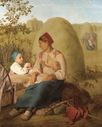
Одной из самых сентиментальных, но при этом загадочных картин художника считается работа «На пашне. Весна». Этот шедевр вызывает много вопросов. Предлагаем вам описание картины Венецианова «На пашне. Весна».
Невозможно представить себе русскую живопись без шедевра Венецианова. На заднем плане картины виднеется распаханное весной поле. Зеленеет трава, потому что края художник оставил нетронутыми. Справа мы видим тоненькие деревья и странный скошенный пень.
На переднем плане полотна перед нами встает очень нарядная молодая крестьянка. На ней розовый сарафан и красивый кокошник. Женщина легкой и плавной походкой ведет за собой двух лошадей, тянущих борону. Крестьянка легко ступает босыми ногами, словно танцует и слегка улыбается.
Справа на переднем плане мы видим младенца. Он спокойно забавляется своими игрушками. Все, что изображено на полотне, очень красиво: пейзаж, женщина, лошади. А также наряд крестьянки, голубое небо и облака.
Мы представляем себе крестьянский труд тяжелым и изнурительным. А на картине Венецианова женщина в праздничном наряде с легкостью справляется с запряженными в бороны лошадьми.
Почему же женщина, занимаясь «черным трудом», идет в праздничной одежде. Где же настоящая правда жизни? Дело в том, что у крестьян первую пахоту приравнивали к празднику.
Еще во времена языческих верований, чтобы задобрить богов плодородия, в деревнях устраивались гулянья.
Венецианов в этой картине не столько погрузился в этнографию и крестьянский быт, как запечатлел проявление вечного бытия. В образе крестьянки, которая гораздо выше лошадей, художник показал прекрасную, легкую, молодую весну, ступающую по земле, обновляющую природу, успокаивающую детей.
На картине «На пашне. Весна» Алексей Гаврилович Венецианов первым среди русских художников показал труд землепашца в виде таинства, чего-то сакрального.
Большие размеры женщины на картине говорят о том, что она несет аллегорический смысл самой весны. Изображение статного и мощного тела крестьянки похоже на искусство высокой античности.
Если внимательно всмотреться в полотно, то и лошади напоминают крылатых Пегасов.
Если смотреть на фото картины, то кажется, что это полотно должно быть больших размеров. На самом деле, картина не такая уж большая и особо не выделяется в коллекции Третьяковской галереи.
The State Tretyakov Gallery
One of the most sentimental, but at the same time mysterious paintings of the artist is considered to be the work " On arable land. Spring". This masterpiece raises many questions. We offer you a description of Venetsianov's painting " On arable land. Spring".
It is impossible to imagine Russian painting without Venetsianov's masterpiece. In the background of the picture, you can see a field plowed in spring. The grass is turning green, because the artist left the edges untouched. On the right we see thin trees and a strange mown stump.
In the foreground of the canvas, a very elegant young peasant woman stands in front of us. She is wearing a pink sundress and a beautiful kokoshnik. A woman with a light and smooth gait leads two horses pulling a harrow. The peasant woman steps lightly with her bare feet, as if dancing and smiling slightly.
On the right in the foreground we see a baby. He is quietly playing with his toys. Everything that is depicted on the canvas is very beautiful: a landscape, a woman, horses. And also the outfit of a peasant woman, blue sky and clouds.
We imagine peasant labor to be hard and exhausting. And in the picture of Venetsianov, a woman in a festive outfit easily copes with horses harnessed to harrows.
Why is it that a woman, engaged in" black labor", goes in festive clothes? Where is the real truth of life? The fact is that the peasants equated the first plowing with a holiday.
Back in the days of pagan beliefs, in order to appease the gods of fertility, festivities were held in the villages.
Venetsianov in this picture was not so much immersed in ethnography and peasant life, as he captured the manifestation of eternal existence. In the image of a peasant woman, who is much taller than horses, the artist showed a beautiful, light, young spring, stepping on the ground, renewing nature, calming children.
In the picture " On the arable land. Spring " Alexey Gavrilovich Venetsianov was the first among Russian artists to show the work of a farmer in the form of a sacrament, something sacred.
The large size of the woman in the picture suggests that she carries the allegorical meaning of spring itself. The image of the stately and powerful body of a peasant woman is similar to the art of high antiquity.
If you look closely at the canvas, then the horses also resemble winged Pegasus.
If you look at the photo of the painting, it seems that this canvas should be large in size. In fact, the picture is not so big and does not stand out particularly in the collection of the Tretyakov Gallery.
| Возможность продажи | - |
| Автор картины | Венецианов А.Г. |
| Техника, материал | Холст, масло 52,3 × 66,7 см |
| Ключевые слова | венецианов жанровая живопись крестьянский быт |
| Размер изображения | 2400 × 1756 px, 873 КБ |
| Добавлено | 14.09.2021 |
| Просмотров | 25 |